


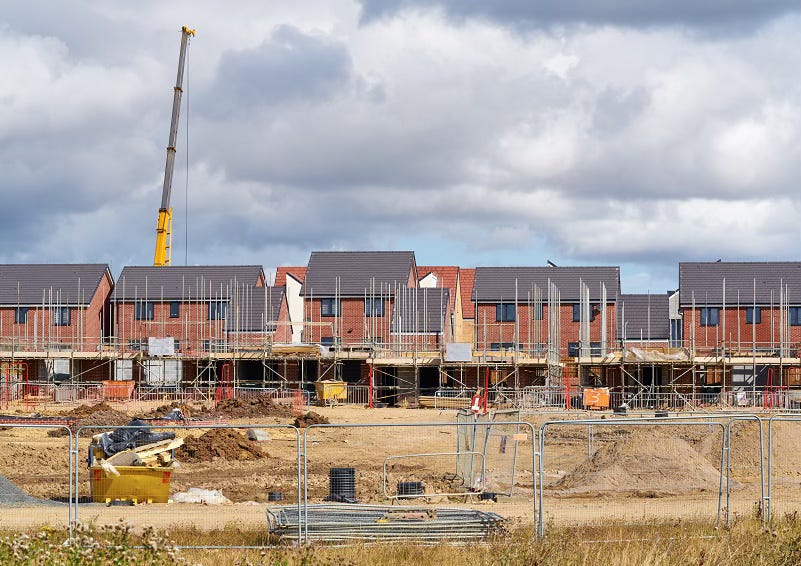
From housing shortages to creaking transport links, the failure to build enough homes and practical infrastructure is now one of the biggest drags on living standards, economic growth, and social cohesion.
This is not an abstract policy debate. It affects whether young people can buy a home, whether families can move for work, whether businesses can invest, and whether communities thrive or stagnate.
A Housing Crisis Years in the Making
Britain faces a chronic shortage of housing. For decades, governments have promised to “build more homes” — yet supply has consistently lagged behind demand. The result is predictable:
house prices far outstripping wages
rents eating up an ever-larger share of income
younger generations locked out of ownership
pressure on social housing lists
Estimates vary, but most agree England is short of hundreds of thousands of homes, with some analyses pointing to a gap of over 4 million built up over time. Immigration has added to demand, while planning bottlenecks and local vetoes have throttled supply.
Planning: Broken, Slow, and Politicised
The planning system is a major part of the problem. It is slow, opaque, and overly centralised — rewarding obstruction rather than delivery. Too often, developments are blocked not because they are poorly designed, but because the system empowers delay and legal challenge.
A Reform-minded approach would be clear:
loosen planning rules to speed up housebuilding
prioritise brownfield development and sensible densification
give communities a stake in development rather than endless consultation without outcomes
Building more homes is not about concreting over the countryside. It is about allowing Britain to grow.
Fairness in Social Housing
There is also a question of fairness. With social housing in short supply, priority must go to those who have contributed and belong here.
Reform UK has argued that British citizens should be prioritised for social housing — not as a slogan, but as a principle of fairness. A system under strain must serve the public that funds it.
Infrastructure: Too Much Grandstanding, Too Little Delivery
Britain’s infrastructure problems are just as serious. While politicians love announcing “transformational” mega-projects, delivery is often late, over budget, or quietly scaled back.
The poster child for this failure is HS2 Ltd — a scheme that ballooned into the tens of billions, delivered far less than promised, and crowded out spending on more practical needs.
Britain does not need vanity projects. It needs:
better roads, especially outside London
reliable local transport
faster broadband and mobile coverage
investment in regional connectivity that actually boosts productivity
Cutting waste from grand projects would free up resources for improvements people use every day.
Build What People Actually Need
Infrastructure should support daily life and economic activity — not political announcements.
That means:
fixing bottlenecks on key roads
upgrading rail where it makes sense
supporting ports, logistics, and energy networks
ensuring rural and coastal areas are not left behind
Britain consistently underperforms peers on infrastructure quality and delivery. That is not because we lack money — it’s because we spend badly.
Reform Means Building Again
Reform UK argues that Britain’s decline is not inevitable. It is the result of choices — especially the choice not to build.
Housing and infrastructure are not “secondary” issues. They sit at the heart of:
the cost-of-living crisis
economic stagnation
regional inequality
generational unfairness
If Britain is serious about reform, it must become serious about construction again — with faster decisions, clearer priorities, and a focus on value for money.
You cannot fix the country while refusing to build the homes and infrastructure it needs.